Most of us agree that increasing government transparency is critical. Trust in all levels of government has reduced - for both legitimate and illegitimate reasons - and the best way to regain trust and deserve trust is transparency.
Government transparency won't magically make everyone happy with every decision, but ideally it will help everyone understand why a decision was made and increase acceptance of decisions with complex positive and negative impacts. As a very simplistic example, imagine if a new stop sign is added and it impacts your commute. You might be frustrated and it might feel like an unfair imposition if you have no idea why this decision was made. However, if it's easy for you look up why the stop sign has been added and see that the decision was made after 10 minor accidents over the last year and complaints from 30 other residents; you may still be frustrated and you may even still disagree with the decision, but you can understand that the decision was not arbitrary.
Transparency is complex and many governments provide minimum transparency. Transparency isn't a societal default. In fact, most of us in our day to day lives aren't exactly transparent when we're asked how we are and answer "fine" - because it is comfortable and easy to provide minimal information. Transparency is hard. Transparency can also backfire when too much information overwhelms or actually decreases understanding. Getting it right will always be an ongoing challenge and often a moving target.
# Barriers to Transparency
There are many barriers to transparency - for both government and citizens.
Cost
From the government side, transparency requires extra work to create ways for the public access information and to ensure that data that should truly be private is kept private. Responding to requests for information has to be factored into staffing and budgets. From the citizen side, FOIPPA request fees can be discouragingly high.
Complexity
When very little information on a topic is public, it can be very difficult to accurately request the desired information through processes like FOIPPA - often making multiple requests necessary. Sometimes information is divided up such that different organizations hold jurisdiction over different pieces of interrelated information. This kind of complexity increases costs and challenges for all involved.
Accessibility of Information
Even when information is technically available and transparently provided, accessibility can be a significant challenge.
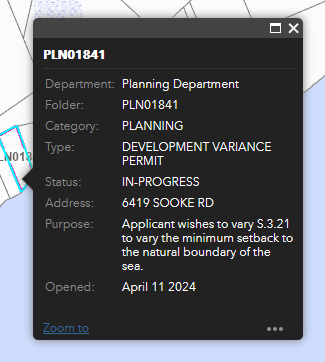 A great example of this type of challenge can be seen in Sooke's Development Application Tracker. This tracker provides important information but also presents many access barriers.
Lets take a walk through finding information as a member of the public (albeit one with significant knowledge of the District of Sooke's processes). Choosing a random item to investigate, let's look at PLN01841 (left).
 We can see that there is a link to zoom to the subject property. Status is "In-Progress" - despite the application have been filed more than 2 years ago. The purpose is a clear single sentence. There is no information about why this application is still in-progress; there's no information about where exactly the process is currently. How could we get more information?
Are there any links? There are map control interfaces - Zoom to/Pan to/Add Marker. Beyond that, there's nothing.
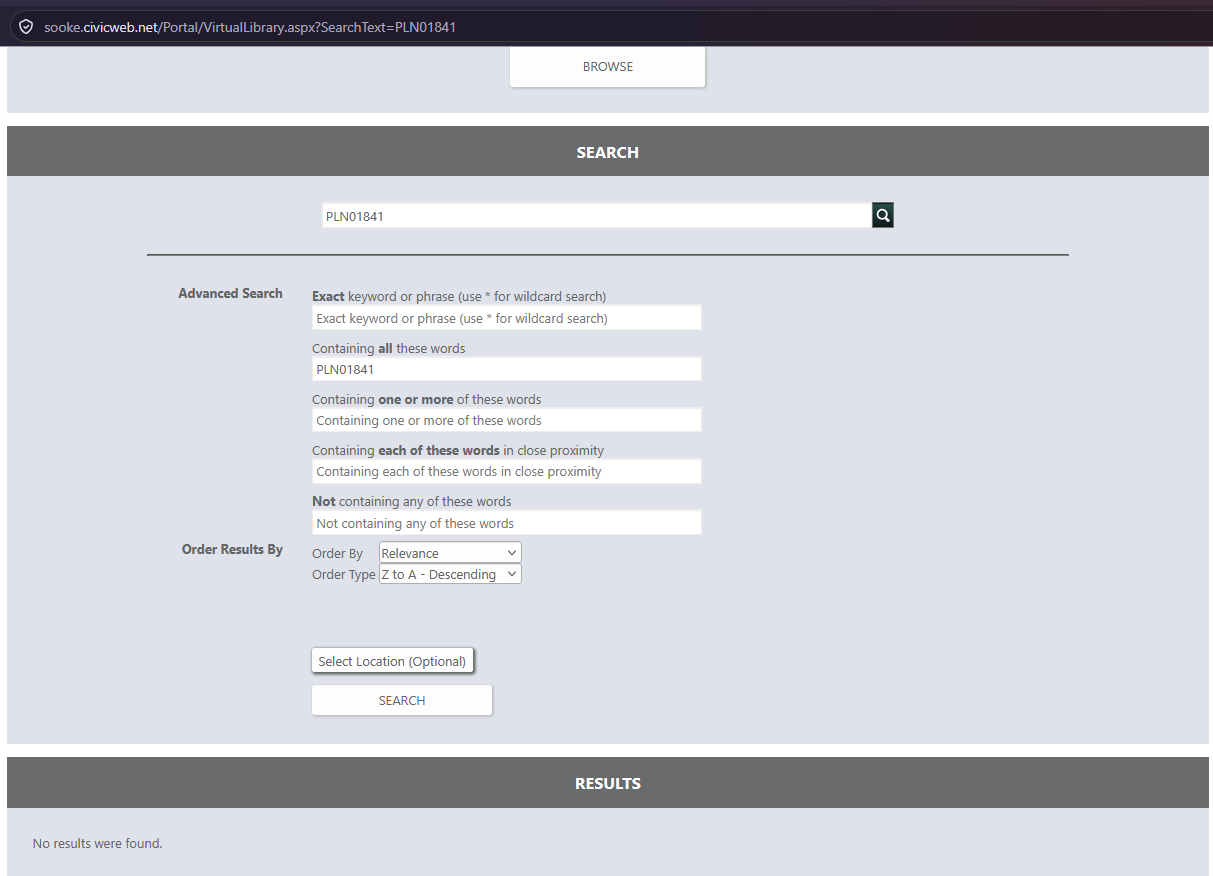
Okay, because we're aware of how the District of Sooke generally works, let's search Sooke's primary document repository - civicweb. (right).
A dead end for information unless you want to call/email - and that's a pretty significant barrier for many. This particular application looks like it only impacts the property itself and maybe 1-2 neighbours.
So let's choose another item to investigate - PLN01860.
- Even less information on the development tracker. Opened more than 2 years ago - June 2024.
- No (useful) links
- No relevant results from a google search.
- Sooke's Civicweb, in this case, does have useful results.
Lets keep digging. If we want to read the update in the October 14th 2025 Council Agenda what do we need to do? Multiple clicks to open a PDF. A 114MB and 1100 page long document. Even if everything up to here was perfectly accessible, that size of document is not accessible in many respects - large file size both in download size and length make navigation hard. In fact that significant size can be a problem for many lower end PCs and phones. Accessibility from a disability standpoint hasn't even been considered and we have multiple layers of blockers to finding the information
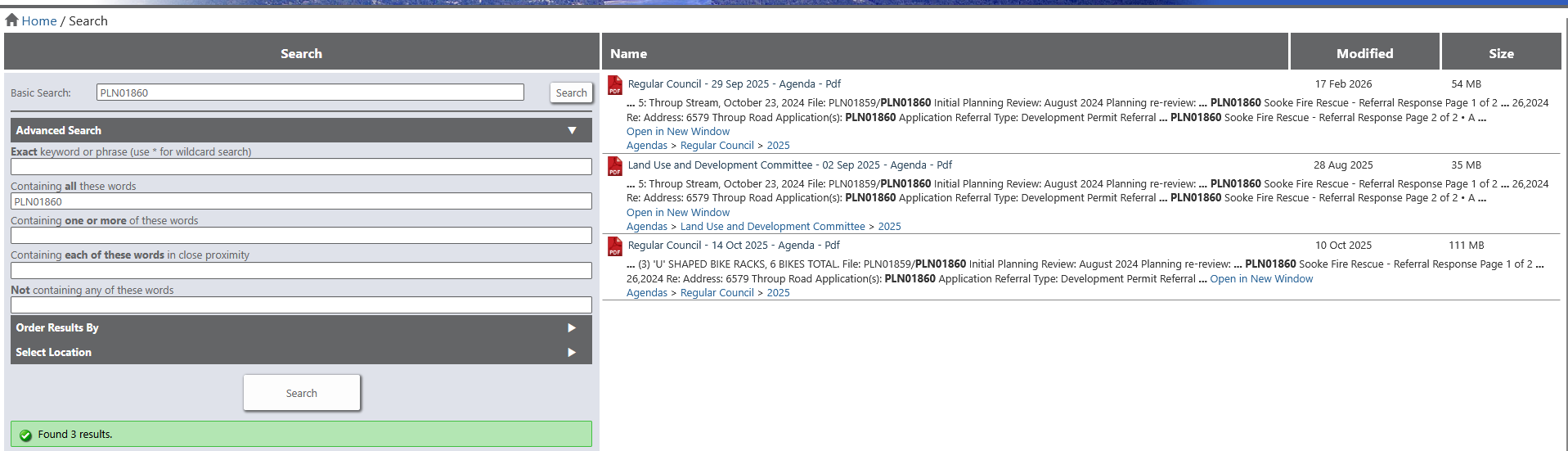
- What if anything was decided at that meeting? There was no search results including that. Another dead-end!
- Luckily for me, I know the system. So I navigate to the Regular Council minutes folder for 2025 (Document Browser -> Minutes -> Regular Council -> 2025), and open up the PDF or HTML options for the minutes. No text search results for PLN01860. So knowing the item from the agenda, I scroll down to item 8.1. And there it is; listed by the address but no mention of the file number.
- So now we know that there was agreement to move forward pending registration of a Sec 219 covenant to achieve a 20m wide cross section for Throup Road. That passed council.
- Now it has been effectively a year. What is the status? We know there is a zoning amendment bylaw. But is it now waiting for staff to do something? The applicant? Is it waiting for time on a council agenda in the future? Have economic or other external factors lead to it being withdrawn? If I was a direct neighbour that lack of clarity would certainly bother me and regardless, although there is information available it really can't be considered transparent - there are too many road blocks to finding it and too many unanswered basic questions.
# What Can We Do?
We need more than lip service to transparency; we need clear actionable plans, staff direction and review. Based on my discussions with residents these are my high priority items to improving transparency if elected:
- Be responsive and answer questions as a councillor. Even if my answer isn't what you want to hear, I will provide as clear and accurate an answer as possible. Unlike most steps to improve transparency, this one is entirely free!
- Improve Development Tracker to provide much more useful and up to date information - this isn't a quick or simple task to accomplish but I believe it will be well worth it.
- Work with emergency services to get more useful reporting. Currently each emergency service reports information in different formats and the reports are often entirely buried in meeting agendas or YouTube recordings - finding and understanding the data is difficult.
There is much more that can and should be done, but these 3 priorities are achievable, high-impact goals from which we can build towards further increases in government transparency.